
Most investors give you one meeting.
Six weeks. Five founders. Live, with me.
You built a real product and earned the early signals. What's ahead runs through rooms you can't afford to fumble: a lead investor, a strategic partner, a first conversation you don't get twice. This is where you build what those rooms expect: the positioning, the commercial clock, the go-to-market economics, the traction narrative for your raise, and the investor pitch assembled from all of it. Built by you, torn apart and rebuilt weekly, until it survives.
A $500 deposit holds your seat and applies to the $10,000. You then have 30 days to pay the balance or arrange payment, and if that doesn't come together the $500 comes back. Stripe handles the payment securely and offers several ways to pay at checkout.





Under two minutes on what you'll leave with.
Five questions your board will ask.
Who buys first, and who signs that check?
What has to be true before you can sell unit one, and what happens if that slips six months?
How does unit one actually get sold, and what does that cost?
What evidence says this is a business and not a science project?
Where is the 24-month commercialization plan, on one page?
If any answer is fuzzy, that is the gap this program closes. Most founders answer the first two with confidence and go quiet by the fourth. That silence is expensive in a boardroom. It is cheap here.
One gate per week. A deliverable every week.
Nothing here is homework for its own sake. Every deliverable is something your board and your raise require anyway, and the weeks stack into one integrated plan.

Five seats. One table. Everyone leaves with the plan.
Positioning and Your Wedge
Who buys first, who signs the check, and the narrowest market where you are the obvious choice: sized bottom-up and set against the competition.
Positioning statement + competitive readThe Commercial Clock
Every constraint between you and revenue (a certification, manufacturing, a platform, a partner) mapped to timeline and cash.
Your constraint map with the cash need at each milestoneThe Go-to-Market Model
Direct, channel, or strategic-led, priced against reality: procurement committees, budget cycles, long closes.
GTM model, unit economics, market mathThe Traction Narrative
Translate technical milestones into evidence investors fund.
The milestone map for your raise, with proof attached to every claimThe Plan-to-Market Roadmap
Gates one through four assembled into one sequenced, budgeted, 12-to-24-month plan, with your team plan. Then the investor pitch skeleton, populated from everything you built.
Board-page roadmap + pitch skeletonBoard-Ready, Pitch-Ready
You present the plan and the pitch. The room attacks both the way a board and a lead investor will. What wobbles gets fixed live.
You leave board-ready and pitch-readyEvery section of the pitch has a week behind it.
Investors expect the same seven sections in every pitch. The weekly gates were built to feed them. Week five is assembly: the pitch skeleton fills from deliverables you already wrote. Week six pressure-tests it.
Intro
What you sell, who pays for it, and why now, in one sentence.
Week 1Team
Who executes the plan, who's missing, and when the hire lands.
Week 5Opportunity
What the problem costs the customer, and a market size built from arithmetic.
Weeks 1 + 3Solution
The offer, the differentiation, and why it holds under pressure.
Week 1Competition
The matrix, with the status quo in it, and why customers switch.
Week 1Business Model
Pricing, unit economics, and the proof you already have.
Weeks 3 + 4The Ask
An amount that buys named milestones and the runway to reach them.
Weeks 2 + 4 + 5
The same process I run inside companies.
I'm Dave Saunders. Thirty years commercializing products as a CTO, CPO, and co-founder across telecom, cloud, and medical devices, including eight years taking a Johns Hopkins surgical-robotics spinout from prototype to market.
My six-month Fractional CPO engagements run $10,000 to $25,000 a month. Plan to Market is the cohort version of the same commercial thinking, for founders who want to build the plan themselves with my hands on it weekly.
40+
products taken to market
30 yrs
in the operator's seat, not the advisor's chair
5
founders per cohort, maximum. Everyone presents, nobody hides.
The people who have watched me do it.
Dave has an uncanny ability to quickly ramp up forward-looking new concepts... and commercialize products. If you are looking for a leader who takes technology-driven concepts to commercialization... Dave is your guy.
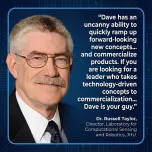
Dr. Russell Taylor
Director, Laboratory for Computational Sensing and Robotics, JHU
His greatest skill is his relentless pursuit to make something work then to make it work even better... always looking at everything through a ‘Shareholders Lens’. He thrives in chaos.
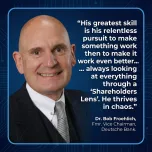
Dr. Bob Froehlich
Fmr. Vice Chairman, Deutsche Bank
Dave brings something most advisors can’t: he’s actually done this. His experience taking a surgical robotics program through FDA clearance has helped us think more clearly about our regulatory path and product structure. That kind of firsthand perspective is hard to find.
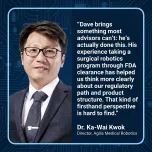
Dr. Ka-Wai Kwok
Director, Agilis Robotics
Five seats. $10,000 each.
Six weekly live sessions of 90 minutes, capped at five founders so every session works on your specific plan. Direct access to me between sessions, every deliverable reviewed weekly. All sessions recorded; you keep the recordings.
Two things I ask of everyone in the first cohort: honest feedback while I'm running it, and a testimonial at the end if the program earns one.
$10,000
A $500 refundable deposit holds a seat.
Balance due within 30 days.
5 seats
Starts when three seats fill.
Enrollment closes at five.
What a seat includes
- Six 90-minute live sessions
- A cohort capped at five founders
- Every deliverable reviewed weekly
- Direct access to me between sessions
- All sessions recorded, yours to keep
- A board-ready plan and investor pitch you present in week six
Finish the six weeks, do the work, and if you don't leave with a board-ready commercialization plan, I keep working with you until you do. Same promise I make on every engagement, and one condition, same as all my work: you show up and do the work.
Or take the call first: 30 minutes, and I'll tell you honestly whether this fits where you are. Email me.
A $500 deposit holds your seat and applies to the $10,000. You then have 30 days to pay the balance or arrange payment, and if that doesn't come together the $500 comes back. Stripe handles the payment securely and offers several ways to pay at checkout.
The ones founders actually ask.
Who is this for?⌄
Founders with a built or near-built product, pre- or early-commercial, typically raising within the next 12 months. Any sector; hard-tech and regulated products are welcome. It is not for idea-stage companies or founders who want the plan done for them; that is what the six-month engagement is for.
How much time does it take?⌄
One 90-minute live session per week, plus two to three hours of work between sessions. Every deliverable is something your board and your raise require anyway. This is not homework on top of the job. It is the job, with structure.
I'm in a regulated space. Does this cover regulatory strategy?⌄
Your regulatory or certification path enters the program as a constraint we map onto your roadmap, cash, and raise in week two. Deep pathway strategy stays with your regulatory advisors; I'm not selling that expertise. What you build here is the commercial plan around those constraints, which is the part most regulated founders are missing.
How is this different from working with you directly?⌄
In the six-month Fractional CPO engagement I join your team and run the product function with you. In Plan to Market, you build the plan yourself with my review and pressure-testing every week, alongside four other founders doing the same. Different depth, different price, same commercial thinking. Many founders start here and some go deeper afterward.
What does the $500 deposit do?⌄
It holds one of the five seats, and it applies to the $10,000. From there you have 30 days to pay the balance or arrange payment with me. If that doesn't come together inside the 30 days, you get the $500 back.
Will there be a self-study version?⌄
Later, at around $2,500, without live access. In the cohort you get me live, working on your specific plan every week.
Need it done with you inside the company instead? That's the six-month Fractional CPO engagement.
The program on twelve slides.
The overview deck: the five gates, the six weeks, what you walk out with, and the terms. Useful if you're taking this to a partner, a co-founder, or your board.
PowerPoint, 85 KB.
Five seats. Then enrollment closes.
Tell me where your product is and what you're raising. If it isn't a fit, I'll say so.
A $500 deposit holds your seat and applies to the $10,000. You then have 30 days to pay the balance or arrange payment, and if that doesn't come together the $500 comes back. Stripe handles the payment securely and offers several ways to pay at checkout.