
Great businesses are built
in base reality.
The fantasy says raise a billion or shut it down. Base reality says: prove people truly want what you're building, then build the business that sustains the people who build it.
Sometimes that's an IPO. More often it's a company that feeds ten families and throws a great Christmas party every year. Both count.
I step in as a fractional CPO and run the product function: the roadmap, the priorities, the risk discipline, and the path to first revenue.
Forty-plus products over thirty-five years: desktop software, SaaS, embedded systems, network hardware, and a surgical robot through FDA De Novo clearance. I've walked this road from the inside.
One hour on your problem, plus follow-up homework. Booked and paid up front.
The Fractional CPO engagement. $10K to $25K per month, six-month minimum.
40+ Products
Commercialized since 1989
FDA De Novo
Clearance · July 2023
$500M/yr
TAOS business unit at Ascend
35 Patents
Licensed from Johns Hopkins
So here's what I see a lot.
A founder has cleared the hardest technical hurdle. The product works. The science is solid. The team has built something genuinely impressive.
But nobody owns the product full time. The roadmap lives in the founder's head and shifts with the loudest customer or the latest board call. Engineering keeps shipping, and nobody is holding the line between what gets built next and what the business needs next: the proof points, the first paying customers, the story that carries the next round.
Underneath it, the structure is thin. User needs are vague. Risk work lives in a stack of spreadsheets. If your product can hurt someone or cost someone serious money, that gap surfaces eventually, whether a regulator is watching your category or not. And it tends to pick the worst possible moment: a diligence call, a design review, a customer incident.
The companies that make it aren't always the ones with the best technology. They're the ones where somebody owns the product end to end and keeps the engineering pointed at the market.
That's the job I do.
Five topics inside the engagement.
One clear methodology.
Inside a six-month Fractional CPO engagement, I run the product function and we move through these five topics together, in the right sequence, at the right depth for where your product is. The work your team produces is something they own, understand, and can defend.
Product and Market Definition
Back to first principles. Intended use. User needs. Indications. System boundaries. Decide what the product actually is, and let everything else flow from that decision.
Productization Roadmap
Bridge the gap between prototype and shippable. Manufacturing readiness. Supplier strategy. Design-for-manufacturability. IP coverage. The path from one working unit to a product that scales.
Quality Culture and Regulatory Pathway
ISO 14971-aligned risk management and design controls installed early, as discipline rather than paperwork. Regulatory strategy defined: 510(k), De Novo, PMA, or your industry's equivalent. Even in categories no regulator touches yet, the same risk discipline is what keeps a high-consequence product safe and sellable.
Verification, Validation, and Design Discipline
User needs and risks translated into clear engineering requirements, traceable all the way through to your test plan. The connective tissue that survives regulatory review and investor diligence.
Go-to-Market and Investor Narrative
Align the commercial story with the technical and regulatory reality. Position the product so it can be sold, funded, and scaled, not just cleared. A development story that holds up in the boardroom the way it holds up in a submission.
The consultants who gave you a slide deck weren't wrong about the destination. They just didn't know how to get there from inside your program.
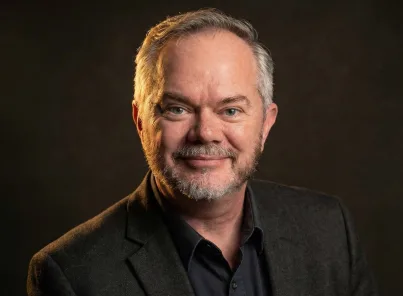
Dave Saunders
Founder, Base Reality Group. Fractional CPO. Forty-plus products commercialized since 1989.
I do.
Forty-plus products commercialized over thirty-five years, and most of them were software: desktop applications, SaaS, embedded systems. The original consumer Wi-Fi hotspot, designed at Bell Labs and shipped by Apple as the AirPort. The TNT access concentrator at Ascend Communications during the dial-up era. A 30-million-line operating system, TAOS, that I branded and productized into a $500M-per-year business unit before Lucent acquired Ascend for $24 billion.
In 2011, surgical robotics found me. Fifteen years and counting. The deepest chapter was eight years as co-founder and CTO of Galen Robotics, taking a Johns Hopkins prototype through three hardware generations, feedback from hundreds of surgeons, two cadaver studies, and FDA De Novo clearance in July 2023 for the world's first cooperatively controlled microsurgical robotic assistant. A 35-patent portfolio licensed from Johns Hopkins, fully granted by the time we cleared. $20M Series A. I provided the core leadership that got that device across the line.
My interest has always been the same. The little gears that bring technology together, and the work on the other side of the fence to get it into customers' hands. The industries change. The problem doesn't.
I know what a clean design history file looks like. I know what a defensible risk framework looks like. I know what a regulator is actually looking for, and I know what a Series B diligence team will find if the structure isn't there.
When you work with me, you're not getting advice from someone who has studied this. You're getting an operator who has done it.
Where I've operated



Recent client work

 Trak Surgical
Corosant Medical
Pharyvac
Trak Surgical
Corosant Medical
Pharyvac
In partnership with ongoing research at Johns Hopkins University Laboratory for Computational Sensory Robotics.
“Dave has an uncanny ability to quickly ramp up forward-looking new concepts... and commercialize products. If you are looking for a leader who takes technology-driven concepts to commercialization... Dave is your guy.”
Dr. Russell Taylor
Director, Laboratory for Computational Sensing and Robotics, JHU
“His greatest skill is his relentless pursuit to make something work then to make it work even better... always looking at everything through a ‘Shareholders Lens’. He thrives in chaos.”
Dr. Bob Froehlich
Fmr. Vice Chairman, Deutsche Bank
“Dave brings something most advisors can’t: he’s actually done this. His experience taking a surgical robotics program through FDA clearance has helped us think more clearly about our regulatory path and product structure. That kind of firsthand perspective is hard to find.”
Dr. Ka-Wai Kwok
Director, Agilis Robotics
“Dave led the team successfully to de Novo clearance with FDA... [and] managed a patent portfolio of 35 applicants, all of which were granted.”
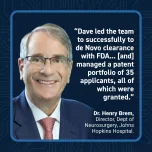
Dr. Henry Brem
Director, Dept of Neurosurgery, Johns Hopkins Hospital
This is for funded founders, seed through Series B, whose product works but whose path to revenue isn't proven yet.
My deepest credential is medical devices and surgical robotics, and most of what I've shipped is software. The method travels: SaaS, desktop, embedded, diagnostics, defense, climate and energy hardware, industrial robotics, physical-AI, connected devices, and the consumer hardware world I've shipped in since the original Apple AirPort.
If you're pre-prototype, looking for general business advice, or hoping someone else will do the hard part for you, this isn't a fit. Two more boundaries worth naming: I'm not a regulatory consultant; the pathway is part of the work, not the whole of it. And I'm not a fundraising advisor; I don't raise money for companies or take fees on a raise.
Running something smaller by design, or not funded yet? I still want you to win. That's what my book and newsletter are for. Start at davesaunders.net.
If you're serious about getting your product to market and you want someone who has done this in your corner, start below.
Two ways to start.
01 / Working Session
One hour on your problem.
You bring the problem. I bring forty-plus products of commercialization experience. We work through what you're facing, and you leave with clear next steps. I send homework after the call and follow up while you work through it. If a longer engagement makes sense, we'll both know.
02 / Fractional CPO Engagement
Senior product leadership inside your company.
Six months minimum. I join your team one to two days a week and run the product function: roadmap, priorities, product and market definition, risk discipline, and the commercial story that carries your next round. Your team learns the method as we go and owns the structure when we're done.
Not sure which? Start with the hour. It's the fastest way for both of us to find out.